Durood Sharif
Durood-e-Taj
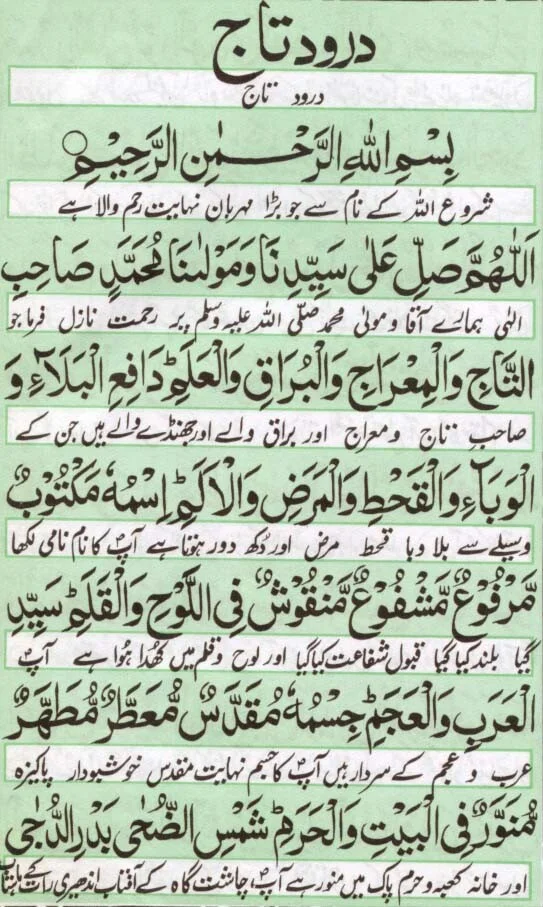
The Durood of the Crown — a salawat, an invocation of blessings upon the Prophet Muhammad ﷺ. It takes its name from its opening line, which addresses him as Sahib al-Taj, the possessor of the crown.
Sending blessings upon the Prophet ﷺ is among the most beloved practices of the Sufi path, and Durood-e-Taj is one of the forms most widely recited across the subcontinent. In the Qadri, Chishti and allied orders — the silsila of this Darbar — it has long been kept as a daily wird, a litany returned to morning and evening.
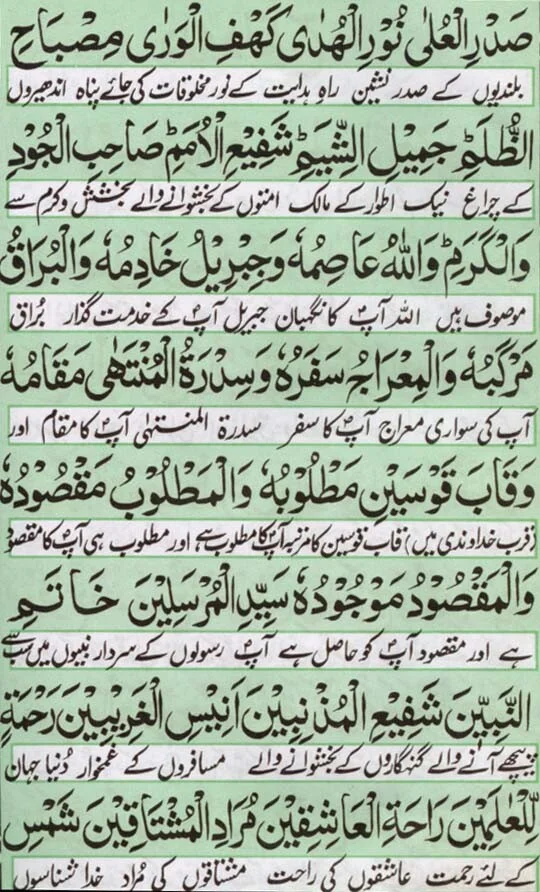
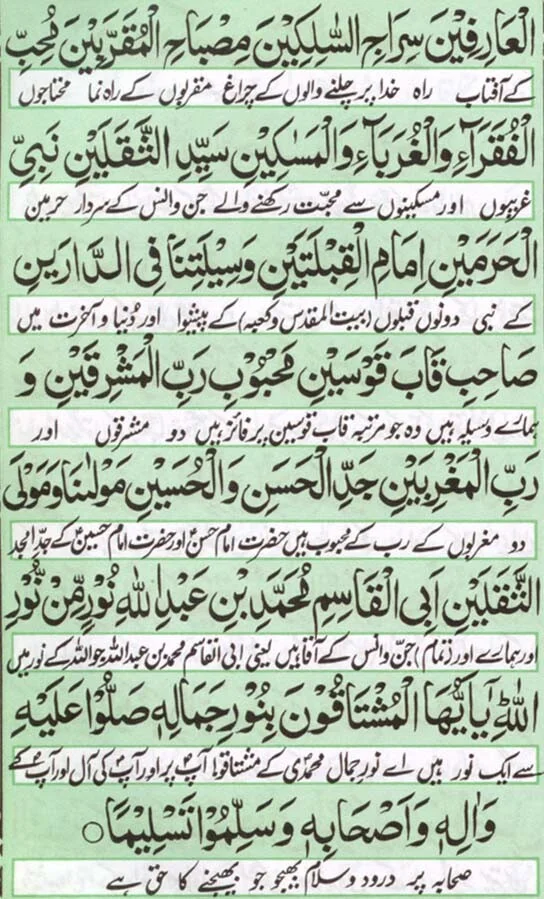
Rather than a petition for oneself, its language is almost entirely praise. It moves through the titles of the Prophet ﷺ one after another — the crown, the ascension, the Buraq and the banner; the sun of the forenoon and the full moon of the darkest night; master of the Arabs and the non-Arabs; intercessor for the sinful, companion to the stranger, and mercy to all the worlds — before closing with peace upon him, his family and his companions.
The full text
Read the Durood
Reproduced from a printed copy, with the Arabic in the upper line of each pair and the Urdu translation beneath it. The text is shown as it was printed — it has not been re-typeset, so nothing is altered in transcription.
Adab
How it is recited
No fixed count is required of anyone. In the tradition of the Darbar it is recited unhurriedly and with presence of heart — the meaning attended to rather than the page hurried through — commonly after Fajr or Isha, and often on Thursday nights and on the Prophet's ﷺ blessed days. Many keep it as a small daily portion rather than a large occasional one.
It is customary to begin and end with blessings upon the Prophet ﷺ, to sit in a state of purity, and to face the qibla where that is easy to do. Beyond that the practice is generous: what is asked is regularity and sincerity, not volume.